JUC
JUC
一、JUC概述
1.1什么是JUC
在Java中,线程部分是一个重点,本篇文章说的JUC也是关于线程的。JUC就是java.util.concurrent工具包的简称。这是一个处理线程的工具包,JDK1.5开始出现的。
1.2进程和线程概念
1.2.1进程
进程(Proces)是计算机中的程序关于某数据结合上的一次运行活动,是系统进行资源分配和调度的基本单位,是操作系统结构的基础。在当代面向线程设计的计算机结构中,进程是线程的容器。程序是指令、数据及其组织形式的描述,进程是程序的实体。是计算机中的程序关于某数据集合上的一次运行活动,是系统进行资源分配和调度的基本单位,是操作系统结构的基础。程序是指令、数据及其组织形式的描述,进程是程序的实体。
1.2.2线程
线程(thread)是操作系统能够进行运算调度的最小单位。它被包含在进程之中,是进程中的实际运作单位。一条线程指的事进程汇总一个单一顺序的控制流,一个进程汇总可以并发多个线程,每条线程并行执行不同的任务。
1.3线程的状态
1.3.1线程状态枚举类
Thread.State
    public enum State {
        /**
         * Thread state for a thread which has not yet started.
         */
        NEW,(新建)

        /**
         * Thread state for a runnable thread.  A thread in the runnable
         * state is executing in the Java virtual machine but it may
         * be waiting for other resources from the operating system
         * such as processor.
         */
        RUNNABLE,(准备就绪)

        /**
         * Thread state for a thread blocked waiting for a monitor lock.
         * A thread in the blocked state is waiting for a monitor lock
         * to enter a synchronized block/method or
         * reenter a synchronized block/method after calling
         * {@link Object#wait() Object.wait}.
         */
        BLOCKED,(阻塞)

        /**
         * Thread state for a waiting thread.
         * A thread is in the waiting state due to calling one of the
         * following methods:
         * <ul>
         *   <li>{@link Object#wait() Object.wait} with no timeout</li>
         *   <li>{@link #join() Thread.join} with no timeout</li>
         *   <li>{@link LockSupport#park() LockSupport.park}</li>
         * </ul>
         *
         * <p>A thread in the waiting state is waiting for another thread to
         * perform a particular action.
         *
         * For example, a thread that has called <tt>Object.wait()</tt>
         * on an object is waiting for another thread to call
         * <tt>Object.notify()</tt> or <tt>Object.notifyAll()</tt> on
         * that object. A thread that has called <tt>Thread.join()</tt>
         * is waiting for a specified thread to terminate.
         */
        WAITING,(不见不散)

        /**
         * Thread state for a waiting thread with a specified waiting time.
         * A thread is in the timed waiting state due to calling one of
         * the following methods with a specified positive waiting time:
         * <ul>
         *   <li>{@link #sleep Thread.sleep}</li>
         *   <li>{@link Object#wait(long) Object.wait} with timeout</li>
         *   <li>{@link #join(long) Thread.join} with timeout</li>
         *   <li>{@link LockSupport#parkNanos LockSupport.parkNanos}</li>
         *   <li>{@link LockSupport#parkUntil LockSupport.parkUntil}</li>
         * </ul>
         */
        TIMED_WAITING,(过时不候)

        /**
         * Thread state for a terminated thread.
         * The thread has completed execution.
         */
        TERMINATED;(终结)
    }
1.3.2wait和sleep
- sleep是Thread的静态方法,wait是Object的方法,任何对象实例都能调用
- sleep不会释放锁,它也不需要占用锁,wait会释放锁,但调用它的前提是当前线程占有锁(代码要在synchronized中)
- 它们都可以被interrupted方法中断
1.4并发与并行
1.4.1并发
同一时刻多个线程在访问同一个资源,多个线程多一个点
例子:春运抢票,电商秒杀
1.4.2并行
多项工作一起执行,之后在汇总
例子:一遍吃饭一遍写代码
1.5管程
是一种同步机制,保证同一时间,只有一个线程访问被保护的数据或代码,JVM同步基于进入和退出,使用管程对象实现的
1.6用户线程和守护线程
1.6.1用户线程
自定义线程
1.6.2守护线程
比如说垃圾回收
主线程结束了,用户线程还在运行,JVM存活
没有用户线程了,都是守护线程,JVM结束
二、Lock接口
2.1Synchronized
2.1.1概念
synchronized是Java中的关键字,是一种同步锁。它修饰的对象有以下几种
- 修饰一个代码块,被修饰的代码块称为同步代码块,起作用的范围是大括号{}括起来的代码,作用的对象是调用这个代码块的对象
- 修饰一个方法,被修饰的方法称为同步方法,起作用的范围是整个方法,作用的对象是调用这个方法的对象
- 修饰一个静态方法,其作用范围是整个静态方法,作用的对象是这个类的所有对象
- 修饰一个类,其作用范围是synchrnoized后面括号括起来的部门,作用的对象是这个类的所有对象
2.1.2Synchrnoized实现卖票的例子
3个售票员 卖出30张票
package com.xzhang;

/**
 * @author xzhang
 * @version 1.0
 * @date 2021/11/24 15:13
 */
public class SaleTicket {
    public static void main(String[] args) {
        //第二步,创建多个线程,调用资源类
        final Ticket ticket = new Ticket();
        new Thread(new Runnable() {
            public void run() {
                for (int i = 0; i < 30; i++) {
                    ticket.sale();
                }
            }
        },"A").start();

        new Thread(new Runnable() {
            public void run() {
                for (int i = 0; i < 30; i++) {
                    ticket.sale();
                }
            }
        },"B").start();

        new Thread(new Runnable() {
            public void run() {
                for (int i = 0; i < 50; i++) {
                    ticket.sale();
                }
            }
        },"C").start();
    }

}

//第一步,创建资源类
class Ticket{
    private int numTicket = 30;
    public synchronized void sale(){
        if(numTicket>=0){
            System.out.println(Thread.currentThread().getName()+":卖出:"+(1)+" 剩下:"+numTicket--);
        }
    }
}
2.1.3Lock接口与Synchronized区别
Lock锁实现提供了比使用同步方法和语句可以获得的更广泛的锁操作。Lock提供了比Synchronized更多的功能
Lock不是Java语言内置的,Synchronized是Java语言的关键字,因此是内置特性。Lock是一个类,通过这个类可以实现同步访问
Lock和Synchronized有一点非常大的不同,采用Synchronized不需要用户手动释放锁,而Lock需要手动释放锁,如果没有释放,就可能导致死锁现象
2.1.4Lock卖票
package com.xzhang;

import java.util.concurrent.locks.ReentrantLock;

/**
 * @author xzhang
 * @version 1.0
 * @date 2021/11/24 15:46
 */
public class SaleTicket2 {
    public static void main(String[] args) {
        final Ticket2 ticket2 = new Ticket2();
        new Thread(new Runnable() {
            public void run() {
                for (int i = 0; i < 50; i++) {
                    ticket2.sale();
                }
            }
        }, "A").start();

        new Thread(new Runnable() {
            public void run() {
                for (int i = 0; i < 50; i++) {
                    ticket2.sale();
                }
            }
        }, "B").start();

        new Thread(new Runnable() {
            public void run() {
                for (int i = 0; i < 50; i++) {
                    ticket2.sale();
                }
            }
        }, "C").start();

    }
}

class Ticket2 {
    private int numTicket = 30;

    //创建可重入锁
    private final ReentrantLock lock = new ReentrantLock();

    public void sale() {
        //上锁
        lock.lock();

        try {
            //判断是否有票
            if (numTicket >= 0) {
                System.out.println(Thread.currentThread().getName() + ":卖出:" + (1) + " 剩下:" + numTicket--);
            }
        } finally {
            //解锁
            lock.unlock();
        }
    }
}
2.1.5线程间的通讯(Synchronized)
package com.xzhang;

/**
 * @author xzhang
 * @version 1.0
 * @date 2021/11/25 10:13
 */
public class Thread1 {
    public static void main(String[] args) {
        final Share share = new Share();
        new Thread(new Runnable() {
            public void run() {
                for (int i = 1; i <= 10; i++) {
                    try {
                        share.incr();
                    } catch (InterruptedException e) {
                        e.printStackTrace();
                    }
                }
            }
        },"A").start();

        new Thread(new Runnable() {
            public void run() {
                for (int i = 1; i <= 10; i++) {
                    try {
                        share.decr();
                    } catch (InterruptedException e) {
                        e.printStackTrace();
                    }
                }
            }
        },"B").start();
    }

}

class Share {
    private int number = 0;

    public synchronized void incr() throws InterruptedException {
        if (number != 0) {
            this.wait();
        }
        number++;
        System.out.println(Thread.currentThread().getName()+":"+number);
        this.notifyAll();
    }

    public synchronized void decr() throws InterruptedException {
        if (number != 1) {
            this.wait();
        }
        number--;
        System.out.println(Thread.currentThread().getName()+":"+number);
        this.notifyAll();
    }

}
2.1.6 虚假唤醒
原因:wait()在哪里睡就在哪里醒
解决方案:把wait()放在循环中
if(number != 1){
	......
    this.wait();
}//使用if会造成虚假唤醒

while(number != 1){
    ......
    this.wait();
}//替换成while,解决虚假唤醒问题
2.1.7线程间的通讯(Lock)
package com.xzhang;

import java.util.concurrent.locks.Condition;
import java.util.concurrent.locks.Lock;
import java.util.concurrent.locks.ReentrantLock;

/**
 * @author xzhang
 * @version 1.0
 * @date 2021/11/25 11:23
 */
public class Thread2 {
    public static void main(String[] args) {
        final Share2 share2 = new Share2();
        new Thread(new Runnable() {
            public void run() {
                for (int i = 0; i < 10; i++) {
                    share2.incr();
                }
            }
        },"A").start();

        new Thread(new Runnable() {
            public void run() {
                for (int i = 0; i < 10; i++) {
                    share2.decr();
                }
            }
        },"B").start();

    }
}

class Share2{
    private int number = 0;

    private Lock lock = new ReentrantLock();
    private Condition condition = lock.newCondition();

    public void incr(){
        lock.lock();
        try{
            while (number != 0){
                condition.await();
            }
            number++;
            System.out.println(Thread.currentThread().getName()+":"+number);
            condition.signalAll();

        } catch (InterruptedException e) {
            e.printStackTrace();
        } finally {
            lock.unlock();
        }
    }

    public void decr(){
        lock.lock();
        try{
            while (number != 1){
                condition.await();
            }
            number--;
            System.out.println(Thread.currentThread().getName()+":"+number);
            condition.signalAll();

        } catch (InterruptedException e) {
            e.printStackTrace();
        } finally {
            lock.unlock();
        }
    }
}
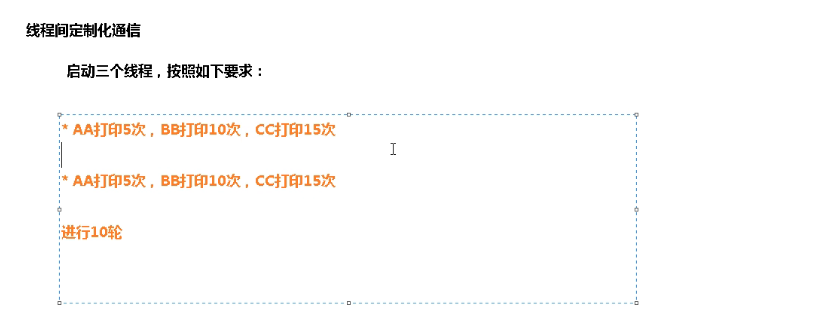
2.1.8线程间的定制化通信
package com.xzhang;

import java.util.concurrent.locks.Condition;
import java.util.concurrent.locks.Lock;
import java.util.concurrent.locks.ReentrantLock;

/**
 * @author xzhang
 * @version 1.0
 * @date 2021/11/26 9:43
 */
public class Thread3 {
    public static void main(String[] args) {
        final ShareResource shareResource = new ShareResource();
        new Thread(new Runnable() {
            public void run() {
                try {
                    for (int i = 1; i <= 10; i++) {
                        shareResource.print5(i);
                    }
                } catch (InterruptedException e) {
                    e.printStackTrace();
                }
            }
        },"A").start();

        new Thread(new Runnable() {
            public void run() {
                try {
                    for (int i = 1; i <= 10; i++) {
                        shareResource.print10(i);
                    }
                } catch (InterruptedException e) {
                    e.printStackTrace();
                }
            }
        },"B").start();

        new Thread(new Runnable() {
            public void run() {
                try {
                    for (int i = 1; i <= 10; i++) {
                        shareResource.print15(i);
                    }
                } catch (InterruptedException e) {
                    e.printStackTrace();
                }
            }
        },"C").start();
    }
}

class ShareResource {
    private int flag = 1;

    private Lock lock = new ReentrantLock();

    //创建3个condition
    private Condition c1 = lock.newCondition();
    private Condition c2 = lock.newCondition();
    private Condition c3 = lock.newCondition();

    public void print5(int loop) throws InterruptedException {
        lock.lock();
        try {
            while (flag != 1) {
                c1.await();
            }
            for (int i = 1; i <= 5; i++) {
                System.out.println(Thread.currentThread().getName() + ":" + i + "轮数:" + loop);
            }
            flag = 2;
            c2.signal();
        } finally {
            lock.unlock();
        }
    }


    public void print10(int loop) throws InterruptedException {
        lock.lock();
        try {
            while (flag != 2) {
                c2.await();
            }
            for (int i = 1; i <= 10; i++) {
                System.out.println(Thread.currentThread().getName() + ":" + i + "轮数:" + loop);
            }
            flag = 3;
            c3.signal();
        } finally {
            lock.unlock();
        }
    }

    public void print15(int loop) throws InterruptedException {
        lock.lock();
        try {
            while (flag != 3) {
                c3.await();
            }
            for (int i = 1; i <= 15; i++) {
                System.out.println(Thread.currentThread().getName() + ":" + i + "轮数:" + loop);
            }
            flag = 1;
            c1.signal();
        } finally {
            lock.unlock();
        }
    }
}
2.1.9多线程编程步骤
创建资源类,在资源类创建属性和操作方法
在资源类操作方法
- 判断
- 干活
- 通知
创建多个线程,调用资源来的操作方法
防止虚假唤醒问题
三、集合的线程安全
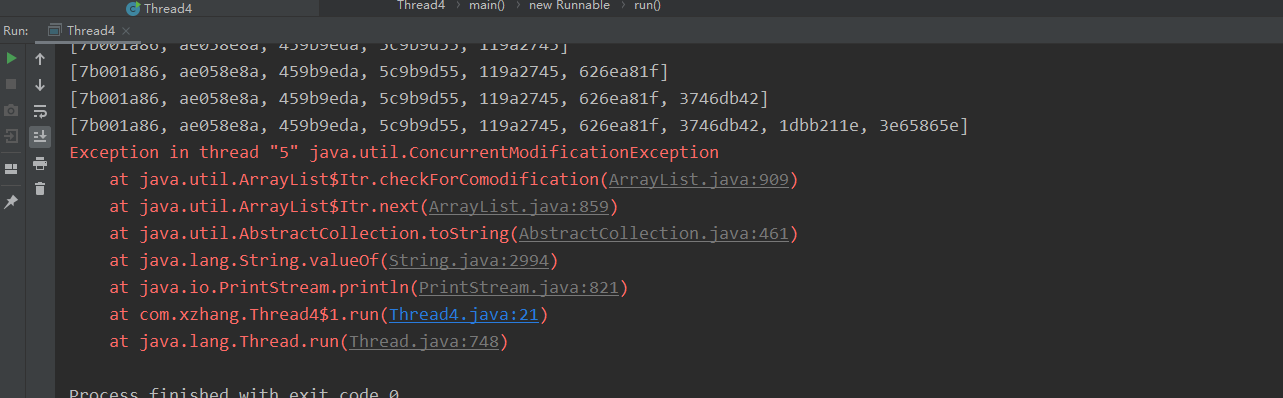
3.1集合线程不安全演示
package com.xzhang;

import java.util.ArrayList;
import java.util.List;
import java.util.UUID;

/**
 * @author xzhang
 * @version 1.0
 * @date 2021/11/26 11:17
 * ArrayList中add()方法没有Synchronized 是线程不安全的
 */
public class Thread4 {
    public static void main(String[] args) {
        List<String> list = new ArrayList<>();
        for (int i = 0; i < 10; i++) {
            new Thread(new Runnable() {
                public void run() {
                    //向集合添加内容
                    list.add(UUID.randomUUID().toString().substring(0, 8));
                    //从集合获取内容
                    System.out.println(list);
                }
            }, String.valueOf(i)).start();
        }

    }
}
3.1.1解决方案-Vector
package com.xzhang;

import java.util.ArrayList;
import java.util.List;
import java.util.UUID;
import java.util.Vector;

/**
 * @author xzhang
 * @version 1.0
 * @date 2021/11/26 11:17
 */
public class Thread4 {
    public static void main(String[] args) {
//        List<String> list = new ArrayList<>();
        List<String> list = new Vector<>();
        for (int i = 0; i < 10; i++) {
            new Thread(new Runnable() {
                public void run() {
                    //向集合添加内容
                    list.add(UUID.randomUUID().toString().substring(0, 8));
                    //从集合获取内容
                    System.out.println(list);
                }
            }, String.valueOf(i)).start();
        }
    }
}
3.1.2解决方案-Collections
package com.xzhang;

import java.util.*;

/**
 * @author xzhang
 * @version 1.0
 * @date 2021/11/26 11:17
 */
public class Thread4 {
    public static void main(String[] args) {
//        List<String> list = new ArrayList<>();
//        List<String> list = new Vector<>();
        List<String> list = Collections.synchronizedList(new ArrayList<>());
        for (int i = 0; i < 10; i++) {
            new Thread(new Runnable() {
                public void run() {
                    //向集合添加内容
                    list.add(UUID.randomUUID().toString().substring(0, 8));
                    //从集合获取内容
                    System.out.println(list);
                }
            }, String.valueOf(i)).start();
        }

    }
}
3.1.3解决方案-CopyOnWriteArrayList(常用)
package com.xzhang;

import java.util.*;
import java.util.concurrent.CopyOnWriteArrayList;

/**
 * @author xzhang
 * @version 1.0
 * @date 2021/11/26 11:17
 */
public class Thread4 {
    public static void main(String[] args) {
//        List<String> list = new ArrayList<>();
//        List<String> list = new Vector<>();
//        List<String> list = Collections.synchronizedList(new ArrayList<>());
        List<String> list = new CopyOnWriteArrayList();
        for (int i = 0; i < 10; i++) {
            new Thread(new Runnable() {
                public void run() {
                    //向集合添加内容
                    list.add(UUID.randomUUID().toString().substring(0, 8));
                    //从集合获取内容
                    System.out.println(list);
                }
            }, String.valueOf(i)).start();
        }

    }
}
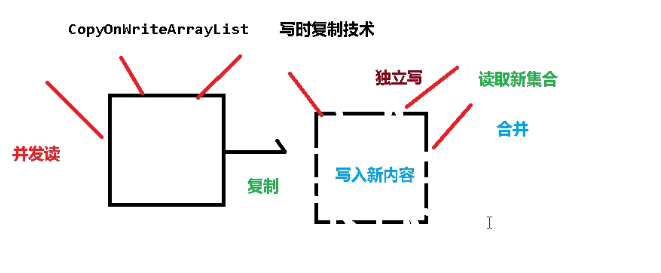
3.1.4写时复制&读时合并
并发读,独立写
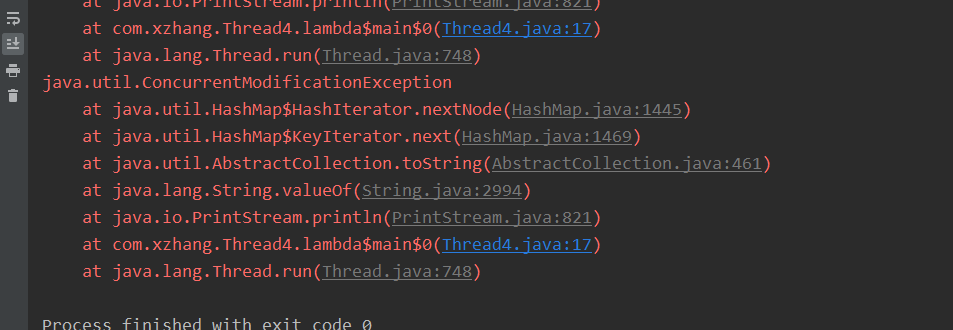
3.2HashSet线程不安全
package com.xzhang;

import java.util.*;
import java.util.concurrent.CopyOnWriteArrayList;

/**
 * @author xzhang
 * @version 1.0
 * @date 2021/11/26 11:17
 */
public class Thread4 {
    public static void main(String[] args) {
        Set<String> set = new HashSet<>();
        for (int i = 0; i < 30; i++) {
            new Thread(()->{
                set.add(UUID.randomUUID().toString().substring(0,8));
                System.out.println(set);
            },String.valueOf(i)).start();
        }
    }
}
3.2.1解决方案-CopyOnWriteSet
package com.xzhang;

import java.util.*;
import java.util.concurrent.CopyOnWriteArrayList;
import java.util.concurrent.CopyOnWriteArraySet;

/**
 * @author xzhang
 * @version 1.0
 * @date 2021/11/26 11:17
 */
public class Thread4 {
    public static void main(String[] args) {
        Set<String> set = new CopyOnWriteArraySet<>();
        for (int i = 0; i < 30; i++) {
            new Thread(()->{
                set.add(UUID.randomUUID().toString().substring(0,8));
                System.out.println(set);
            },String.valueOf(i)).start();
        }
    }
}
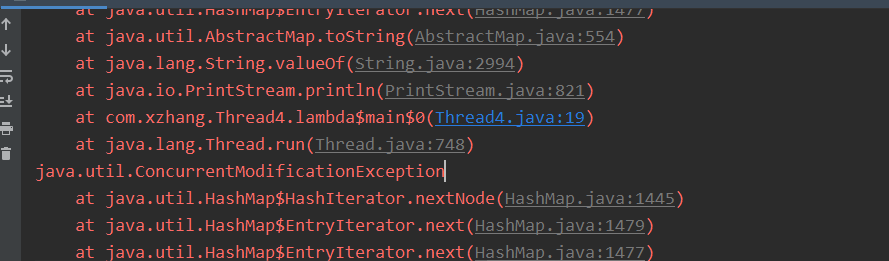
3.3HashMap线程不安全
package com.xzhang;

import java.util.*;
import java.util.concurrent.CopyOnWriteArrayList;
import java.util.concurrent.CopyOnWriteArraySet;

/**
 * @author xzhang
 * @version 1.0
 * @date 2021/11/26 11:17
 */
public class Thread4 {
    public static void main(String[] args) {
        Map<String, String> map = new HashMap<>();
        for (int i = 0; i < 30; i++) {
            String key = String.valueOf(i);
            new Thread(() -> {
                map.put(key, UUID.randomUUID().toString().substring(0, 8));
                System.out.println(map);
            }, String.valueOf(i)).start();
        }
    }
}
3.3.1解决方案-ConcurrentHashMap
package com.xzhang;

import java.util.*;
import java.util.concurrent.ConcurrentHashMap;
import java.util.concurrent.CopyOnWriteArrayList;
import java.util.concurrent.CopyOnWriteArraySet;

/**
 * @author xzhang
 * @version 1.0
 * @date 2021/11/26 11:17
 */
public class Thread4 {
    public static void main(String[] args) {
        Map<String, String> map = new ConcurrentHashMap<>();
        for (int i = 0; i < 30; i++) {
            String key = String.valueOf(i);
            new Thread(() -> {
                map.put(key, UUID.randomUUID().toString().substring(0, 8));
                System.out.println(map);
            }, String.valueOf(i)).start();
        }
    }
}
四、多线程锁
4.1Synchronized
4.1.1Synchronized修饰 普通同步方法,锁住的是当前对象
class Phone{
    public synchronized void sendSMS() throws Exception{
        TimeUnit.SECONDS.sleep(4);
        System.out.println("-----sendSMS");
    }
    public synchronized void sendEmail() throws Exception{
        System.out.println("-----sendEmail");
    }
}
4.1.2Synchronized修饰静态同步方法,锁住的是当前类的Class对象
class Phone{
    public synchronized static void sendSMS() throws Exception{
        TimeUnit.SECONDS.sleep(4);
        System.out.println("-----sendSMS");
    }
    public synchronized static void sendEmail() throws Exception{
        System.out.println("-----sendEmail");
    }
}
4.1.3Synchronized修饰同步方法块,锁住的是Synchronized括号里配置的对象
class Phone{
    public void sendHello(){
        synchronized(this) {
            System.out.println("sendHello");
        }
    }
}
4.2 公平锁和非公平锁
4.2.1源码
- 两个构造器
- 无参构造器默认非公平锁
- 有参构造器可以传入参数
 /**
     * Creates an instance of {@code ReentrantLock}.
     * This is equivalent to using {@code ReentrantLock(false)}.
     */
    public ReentrantLock() {
        sync = new NonfairSync();
    }

    /**
     * Creates an instance of {@code ReentrantLock} with the
     * given fairness policy.
     *
     * @param fair {@code true} if this lock should use a fair ordering policy
     */
    public ReentrantLock(boolean fair) {
        sync = fair ? new FairSync() : new NonfairSync();
    }
4.2.2特点
非公平锁
- 线程饿死
- 执行效率高
公平锁
- 阳光普照
- 执行效率低
4.3可重入锁(递归锁)
Synchronized和Lock都是可重入锁
Synchronized是隐式的
Lock是显式的
4.3.1 Synchronized
package com.xzhang;

/**
 * @author xzhang
 * @version 1.0
 * @date 2021/11/26 15:54
 */
public class Lock {
    public static void main(String[] args) {
        Object o = new Object();
        new Thread(()->{
            synchronized (o){
                System.out.println(Thread.currentThread().getName()+":外层");
                synchronized (o){
                    System.out.println(Thread.currentThread().getName()+":中层");
                    synchronized (o){
                        System.out.println(Thread.currentThread().getName()+":内层");
                    }
                }
            }
        },"A").start();
    }
}
4.3.2Lock
package com.xzhang;

import java.util.concurrent.locks.Lock;
import java.util.concurrent.locks.ReentrantLock;

/**
 * @author xzhang
 * @version 1.0
 * @date 2021/11/26 15:54
 */
public class LockThread {

    public static void main(String[] args) {
        Lock lock = new ReentrantLock();
        new Thread(() -> {
            try {
                lock.lock();
                System.out.println(Thread.currentThread().getName() + "外层");
                try {
                    lock.lock();
                    System.out.println(Thread.currentThread().getName() + "中层");
                    try {
                        lock.lock();
                        System.out.println(Thread.currentThread().getName() + "内层");
                    } finally {
                        lock.unlock();
                    }
                } finally {
                    lock.unlock();
                }
            } finally {
                lock.unlock();
            }
        }, "A").start();

    }
}
4.4死锁
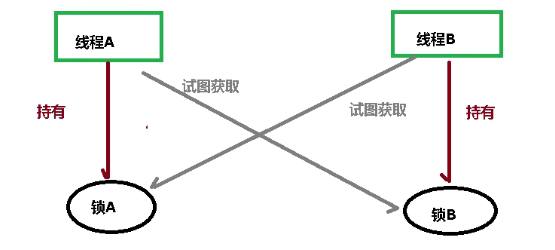
4.4.1什么是死锁
两个或者两个以上的进程在执行过程中,因为争夺资源而造成一直陪你过互相等待的现象,如果没有外力的干涉,它们无法再执行下去
4.4.2产生死锁的原因
- 系统资源不足
- 进程运行过程中推进的顺序是不合适的
- 资源分配不当
4.4.3演示
package com.xzhang;

/**
 * @author xzhang
 * @version 1.0
 * @date 2021/11/26 16:26
 */
public class DeadLock {
    static Object a = new Object();
    static Object b = new Object();
    public static void main(String[] args) {
        new Thread(()->{
            synchronized (a){
                System.out.println(Thread.currentThread().getName()+"已经持有锁a,试图获取锁b");
                synchronized (b){
                    System.out.println(Thread.currentThread().getName()+"获取锁b");
                }
            }
        },"A").start();

        new Thread(()->{
            synchronized (b){
                System.out.println(Thread.currentThread().getName()+"已经持有锁b,试图获取锁a");
                synchronized (a){
                    System.out.println(Thread.currentThread().getName()+"获取锁a");
                }
            }
        },"A").start();

    }
}
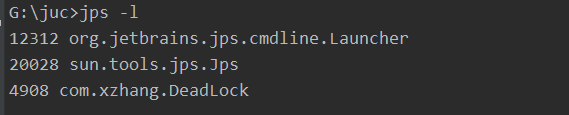
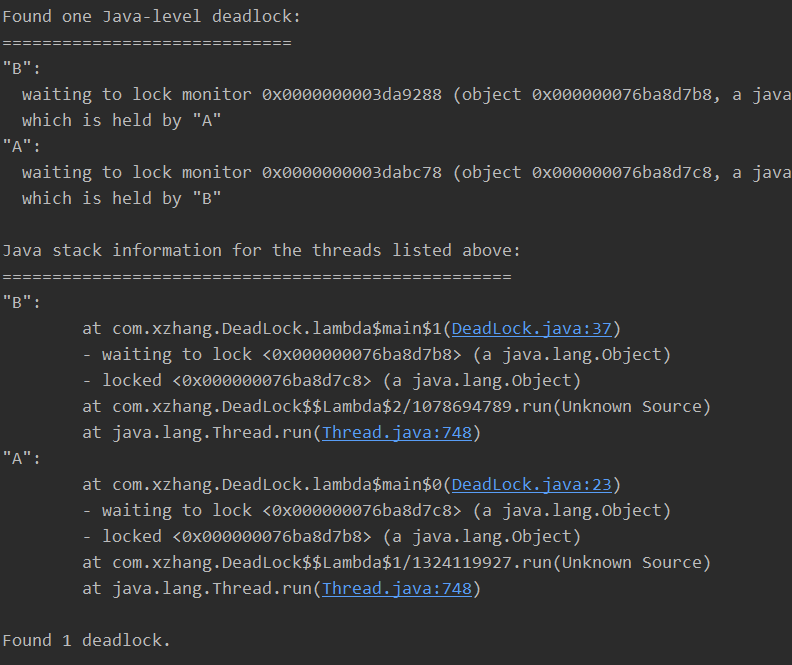
4.4.4验证是否是死锁
- jps (ps -ef)
- jstack jvm自带的堆栈跟踪工具
五、Callable接口
5.1创建线程的方式
5.1.1Thread类
继承Thread类
5.1.2Runable接口
实现Runable接口
5.1.3Callable接口
实现Callable接口
5.1.4线程池
ThreadPool
5.2Runable和Callable区别
5.2.1返回值
- Callbale有返回值
- Runnable无返回值
5.2.2异常
- Callable接口无计算结果会抛出异常
- Runnable接口不会抛出异常
5.2.3实现方法
- Callable实现call()方法
- Runnable实现run()方法
5.3通过Callable接口创建线程
5.3.1 中间类FutureTask
Thread类中没有参数类型为Callable的构造参数
找一个类,既和Runnable有关系,又和Callable有关系
Runnable接口有实现类FutureTask
FutureTask构造可以传递Callable
FutuerTask叫做未来任务
package com.xzhang;

import java.util.concurrent.Callable;
import java.util.concurrent.Future;
import java.util.concurrent.FutureTask;

/**
 * @author xzhang
 * @version 1.0
 * @date 2021/11/26 17:42
 */
public class ThreadCompare  {
    public static void main(String[] args) {
        new Thread(new ThreadFirst(),"A").start();
        //传统形式
        FutureTask<Integer> future1  = new FutureTask<>(new ThreadSecond());
        //lam表达式形式
        FutureTask<Integer> future2  = new FutureTask<>(()->{
            return 100;
        });
    }
}

class ThreadFirst implements Runnable{

    @Override
    public void run() {

    }
}

class ThreadSecond implements Callable{

    @Override
    public Integer call() throws Exception {
        return 200;
    }
}
5.3.2未来任务
- 我在拉屎,想喝水,去买水不合适,拉屎会中断
- 单开启线程找别人帮你买
- 水买回来,需要的时候直接get
六、JUC强大的辅助类
6.1减少计数CountDownLatch
CountDownLatch类可以设置一个计数器,然后通过counntDown方法来进行减1操作,使用await方法等待计数器不大于0,然后继续执行await方法之后的语句
- CountDownLatch主要有两个方法,当一个或者多个线程调用await方法时,这些线程会阻塞
- 其他线程调用CountDown方法会讲计数器减1(调用CountDown方法的线程不会阻塞)
- 当计数器的值变为0时,因await方法阻塞的线程会被唤醒,继续执行
import java.util.concurrent.CountDownLatch;

public class CountDownLatchDemo {
    public static void main(String[] args) throws InterruptedException {
        System.out.println("===============");
        CountDownLatch countDownLatch = new CountDownLatch(10);
        for (int i = 1; i <= 10; i++) {
            new Thread(()->{
                System.out.println(Thread.currentThread().getName()+" 号员工下班了");
                countDownLatch.countDown();
            },String.valueOf(i)).start();
        }

        countDownLatch.await();
        System.out.println("老板下班了");
    }
}
6.2循环栅栏CyclicBarrier
一个同步辅助类,它允许一组线程互相等待,知道到达某个公共屏障点,在设计一组固定大小的线程的程序中,这些线程必须不时的相互等待,此时CycliBarrier很有用,因为该barrier在释放等待线程后可以重用
import java.util.concurrent.BrokenBarrierException;
import java.util.concurrent.CyclicBarrier;

public class CyclicBarrierDemo {
    private static int number = 7;
    public static void main(String[] args) {
        CyclicBarrier cyclicBarrier = new CyclicBarrier(number, () -> {
            System.out.println("集齐七颗龙珠召唤神龙!!!");
        });

        for (int i = 1; i <=7; i++) {
            new Thread(()->{
                try {
                    System.out.println(Thread.currentThread().getName()+"颗龙珠获取到");
                    cyclicBarrier.await();
                } catch (InterruptedException e) {
                    e.printStackTrace();
                } catch (BrokenBarrierException e) {
                    e.printStackTrace();
                }
            },String.valueOf(i)).start();
        }

    }
}
6.信号灯Semaphore
一个计数信号量,从概念上讲,信号量维护了一个许可集。如果有必要,在许可可用前会阻塞每一个acquire(),然后再活的该许可。每个release()添加一个许可,从而可能释放一个正在阻塞的获取者。但是,不适用实际的许可对象,Semaphore只对可用许可的号码进行技术,并采取相应的行动。
package com.xzhang;

import java.util.concurrent.Semaphore;
import java.util.concurrent.TimeUnit;

/**
 * @author xzhang
 * @version 1.0
 * @date 2021/11/29 9:36
 */

//6辆汽车,停在3个停车位
public class SemaPhoreDemo {
    public static void main(String[] args) {
        //创建Semaphore,设置许可数量
        Semaphore semaphore = new Semaphore(3);

        //模拟6辆汽车
        for (int i = 1; i <=6 ; i++) {
            new Thread(()->{
                //抢占
                try {
                    semaphore.acquire();
                    System.out.println("第 "+Thread.currentThread().getName()+" 辆汽车抢到车位");
                    //设置抢占时间
                    TimeUnit.SECONDS.sleep(1);
                    System.out.println("第 "+Thread.currentThread().getName()+" 辆汽车----------离开车位");
                } catch (InterruptedException e) {
                    e.printStackTrace();
                }finally {
                    semaphore.release();
                }
            },String.valueOf(i)).start();
        }
    }
}
七、读写锁
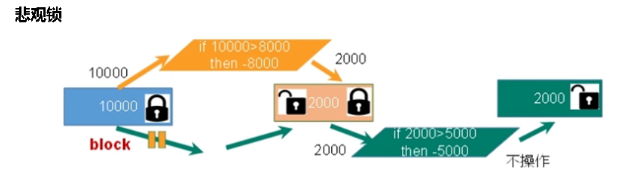
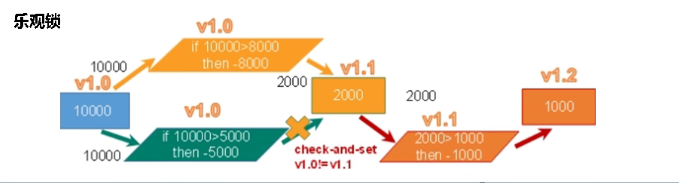
7.1乐观锁&悲观锁
7.2表锁&行锁
一张表中有100条数据,处理第5条
表锁:整张表上锁,所有行都不能操作
行锁:第5条上锁,其他的所有行均可操作
7.3读锁&写锁
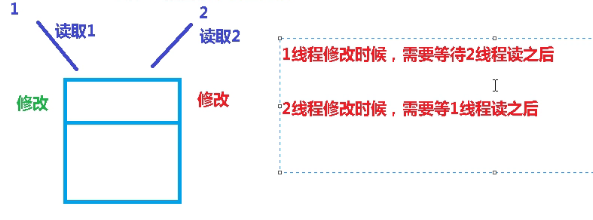
读锁:共享锁,有可能发生死锁
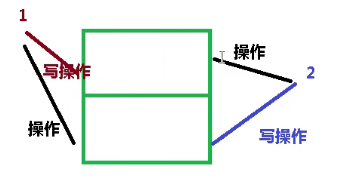
写锁:独占锁,有可能发生死锁
7.4读写锁演示
package com.xzhang;

import java.util.HashMap;
import java.util.Map;
import java.util.concurrent.TimeUnit;
import java.util.concurrent.locks.Lock;
import java.util.concurrent.locks.ReadWriteLock;
import java.util.concurrent.locks.ReentrantReadWriteLock;

/**
 * @author xzhang
 * @version 1.0
 * @date 2021/11/29 9:56
 */
public class ReadWriteLockDemo {
    public static void main(String[] args) {
        MyCache myCache = new MyCache();
        for (int i = 1; i <=5 ; i++) {
           final  int finalI = i;
            new Thread(()->{
                myCache.put(finalI+"", finalI+"");
            },String.valueOf(i)).start();
        }

        for (int i = 1; i <=5 ; i++) {
            final  int finalI = i;
            new Thread(()->{
                myCache.get(finalI+"");
            },String.valueOf(i)).start();
        }
    }
}

class MyCache{
    private volatile Map<String,Object> map = new HashMap<>();
    //创建读写锁
    private ReadWriteLock rwLock = new ReentrantReadWriteLock();

    public void  put(String key ,Object value){
        //添加写锁
        Lock lock = rwLock.writeLock();
        lock.lock();
        try {
            System.out.println(Thread.currentThread().getName()+"正在进行写操作"+key);
            TimeUnit.MICROSECONDS.sleep(100);
            map.put(key,value);
            System.out.println(Thread.currentThread().getName()+"写完了"+key);
        } catch (InterruptedException e) {
            e.printStackTrace();
        }finally {
            lock.unlock();
        }

    }

    public  Object  get(String key ){
        Object result = null;
        ReadWriteLock rwLock = new ReentrantReadWriteLock();
        Lock lock = rwLock.readLock();
        lock.lock();
        try {
            System.out.println(Thread.currentThread().getName()+"正在取数据"+key);
            TimeUnit.MICROSECONDS.sleep(100);
            result = map.get(key);
            System.out.println(Thread.currentThread().getName()+"取完了"+key);
        } catch (InterruptedException e) {
            e.printStackTrace();
        }finally {
            lock.unlock();
        }
        return  result;
    }
}
7.5锁的演变
读写锁:一个资源可以被多个读线程访问,或者可以被一个写线程访问,但是不能同时存在读写操作,读写互斥,读读共享
| 无锁 | 添加锁 | 读写锁 |
|---|---|---|
| 多个线程抢占资源 | 使用Synchronized和ReentrantLock | ReentrantReadWriteLock |
| 乱 | 都是独占的,每次只能一个操作 | 读读 可以共享,提升性能,同时多人进行读操作 |
| 读读 1,不能共享 | 写写 1 | |
| 读写 1 | 缺点: | |
| 写写 1 | 造成锁饥饿,一直读,没有写操作 | |
| 读的时候,不能写,只有读完成之后,才可以写,写操作可以读 | ||
7.6锁的降级
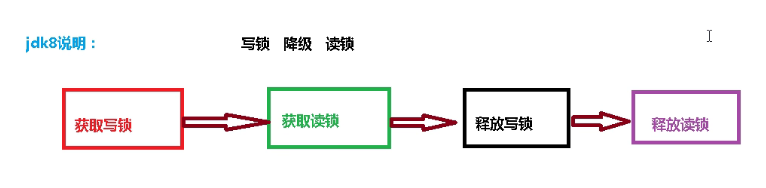
将写锁降级为读锁,读锁不能升级为写锁
package com.xzhang;

import java.util.concurrent.locks.ReentrantReadWriteLock;

/**
 * @author xzhang
 * @version 1.0
 * @date 2021/11/29 10:42
 */
public class LowerLock {
    public static void main(String[] args) {
        //可重入对写锁对象
        ReentrantReadWriteLock rwLock = new ReentrantReadWriteLock();

        //分别创建读写锁
        ReentrantReadWriteLock.ReadLock readLock = rwLock.readLock();
        ReentrantReadWriteLock.WriteLock writeLock = rwLock.writeLock();

        //锁降级
        writeLock.lock();
        System.out.println("获取写锁");
        readLock.lock();
        System.out.println("获取读锁");
        writeLock.unlock();
        System.out.println("释放写锁");
        readLock.unlock();
        System.out.println("释放读锁");
    }
}
八、阻塞队列
8.1概述
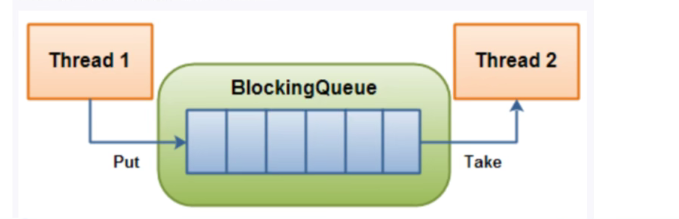
阻塞队列,首先是一个队列,通过一个共享的队列,可以使得数据由队列的一端输入,另一端输出

8.2分类

8.2.1ArrayBlockingQueue(常用)
基于数组的阻塞队列实现,在其内部,维护了一个定长数组,一遍缓存队列中的数据对象,除了一个订场数组外,在其内部还保存着两个整型变量,分别标识着队列的头部和尾部在数组中的位置。
由数组结构组成的有界阻塞队列
8.2.2LinkedBlockingQueue(常用)
由链表结构组成的有界阻塞队列
默认大小值为 integer.MAX_VALUE
8.2.3DelayQueue
使用优先级队列实现的延迟无界阻塞队列
8.2.4PriorityBlockingQueue
支持优先级排序的无界阻塞队列
8.2.5SynchronousQueue
不存储元素的阻塞队列,也即单个元素的队列
8.2.6LinkedTransferQueue
由链表组成的无界阻塞队列
8.2.7LinkedBlockingQueue
由链表组成的双向阻塞队列
8.3核心方法
8.3.1方法分类
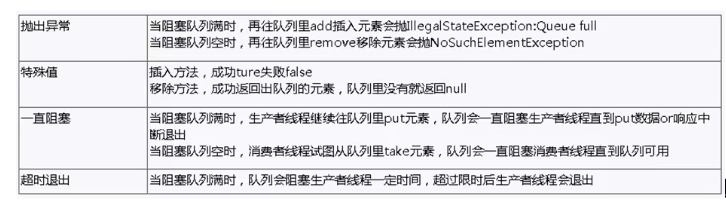
| 方法类型 | 抛出异常 | 特殊值 | 阻塞 | 超时 |
|---|---|---|---|---|
| 插入 | add(e) | offer(e) | put(e) | offer(e,time,unit) |
| 移除 | remove() | poll() | take() | poll(time,unit) |
| 检查 | element() | peek() | 不可用 | 不可用 |
8.3.2 演示
package com.xzhang;

import java.util.concurrent.ArrayBlockingQueue;
import java.util.concurrent.BlockingQueue;
import java.util.concurrent.TimeUnit;

/**
 * @author xzhang
 * @version 1.0
 * @date 2021/11/29 13:52
 */
public class BlockingQueueDemo {
    public static void main(String[] args) throws InterruptedException {
        BlockingQueue<String> blockingQueue = new ArrayBlockingQueue(1);
        System.out.println(blockingQueue.add("a"));
        System.out.println(blockingQueue.element());
        System.out.println(blockingQueue.remove());

        System.out.println(blockingQueue.offer("b"));
        System.out.println(blockingQueue.offer("c"));
        System.out.println(blockingQueue.peek());
        System.out.println(blockingQueue.poll());
        System.out.println(blockingQueue.peek());
        System.out.println(blockingQueue.poll());


        blockingQueue.put("d");
//        blockingQueue.put("f");
        System.out.println(blockingQueue.take());
//        System.out.println(blockingQueue.take());

        System.out.println(blockingQueue.offer("e"));
        System.out.println(blockingQueue.offer("f", 3L, TimeUnit.SECONDS));
    }
}
九、线程池
9.1线程池概述
9.1.1概念
线程池是一种线程使用模式,线程过多会带来调度开销,进而影响缓存局部性和整体性能。而线程池维护者多个线程,等待着监督管理者分配可并发执行的任务。这避免了在处理短时间任务时创建与销毁线程的代价。线程池不仅能够保证内核的充分利用,还能防止过分调用。
9.1.2优势
线程池做的工作主要是控制运行的线程数量,处理过程汇总将任务放入队列,然后在线程创建后启动这些任务,如果线程数量超过了最大数量,超出数量的线程排队等候,等待其他线程执行完毕,再从队列中取出任务来执行。
9.1.4特点
降低资源消耗:通过重复利用已经创建的线程降低线程创建和小慧造成的消耗
提高响应速度:当任务到达时,任务可以不需要等待线程创建就能立即执行
提高线程的可管理性:线程是稀缺资源,如果无限制的创建,不仅会消耗系统资源,还会降低系统的稳定性,使用线程池统一的分配,调优和监控。
9.2架构
Java中的线程池是通过Executor框架实现的,该框架中用到了Executor,Executors,ExecutorService,ThreadPoolExecutor
9.3分类
9.3.1Executors.newFixedThredPool(int)
一池N线程
特点:
- 线程池中的线程处于一定的量,可以很好的控制线程的并发量
- 线程可以重复被使用,在显式关闭前,都将一直存在
- 超出一定量的线程被提交时,需要在队列中等待
package com.xzhang.pool;

import java.util.concurrent.ExecutorService;
import java.util.concurrent.Executors;

/**
 * @author xzhang
 * @version 1.0
 * @date 2021/11/29 15:32
 */
public class ThreadPoolDemo1 {
    public static void main(String[] args) {
        ExecutorService threadPool = Executors.newFixedThreadPool(5);
        try{
            for (int i = 1; i <=10 ; i++) {
                threadPool.execute(()->{
                    System.out.println(Thread.currentThread().getName()+"正在执行");
                });
            }
        }catch (Exception e){
            e.printStackTrace();
        }finally {
            threadPool.shutdown();
        }
    }
}
9.3.2Executors.newSingleThreadExecutor()
一个任务一个任务的执行,一池一线程
package com.xzhang.pool;

import java.util.concurrent.ExecutorService;
import java.util.concurrent.Executors;

/**
 * @author xzhang
 * @version 1.0
 * @date 2021/11/29 15:32
 */
public class ThreadPoolDemo1 {
    public static void main(String[] args) {
        ExecutorService threadPool = Executors.newFixedThreadPool(5);
        ExecutorService threadPool2 = Executors.newSingleThreadExecutor();
        try{
            for (int i = 1; i <=10 ; i++) {
                threadPool2.execute(()->{
                    System.out.println(Thread.currentThread().getName()+"正在执行");
                });
            }
        }catch (Exception e){
            e.printStackTrace();
        }finally {
            threadPool2.shutdown();
        }
    }
}
9.3.3Executors.newCachedThreadPool()
线程池根据需求创建线程,可扩容,遇强则强
package com.xzhang.pool;

import java.util.concurrent.ExecutorService;
import java.util.concurrent.Executors;

/**
 * @author xzhang
 * @version 1.0
 * @date 2021/11/29 15:32
 */
public class ThreadPoolDemo1 {
    public static void main(String[] args) {
        ExecutorService threadPool = Executors.newFixedThreadPool(5);
        ExecutorService threadPool2 = Executors.newSingleThreadExecutor();
        ExecutorService threadPool3 = Executors.newCachedThreadPool();
        try{
            for (int i = 1; i <=10 ; i++) {
                threadPool3.execute(()->{
                    System.out.println(Thread.currentThread().getName()+"正在执行");
                });
            }
        }catch (Exception e){
            e.printStackTrace();
        }finally {
            threadPool3.shutdown();
        }
    }
}
9.4底层原理
上面几种创建线程池的方法都是使用了ThreadPoolExecutor
一共有七个参数
9.4.1
int corePoolSize //常驻线程数量(核心)9.4.2
int maxmumPoolSize //最大线程数量9.4.3
long keepAliveTime //存活时间9.4.4
Timeunit unit //时间单位9.4.5
BlockingQueue<Runnable> workQueue //阻塞队列9.4.6
ThreadFactory threadFactory //线程工厂9.4.7
RejectedExecutionHandler handler//拒绝策略9.5工作流程
9.5.1执行流程图
9.5.2两个细节
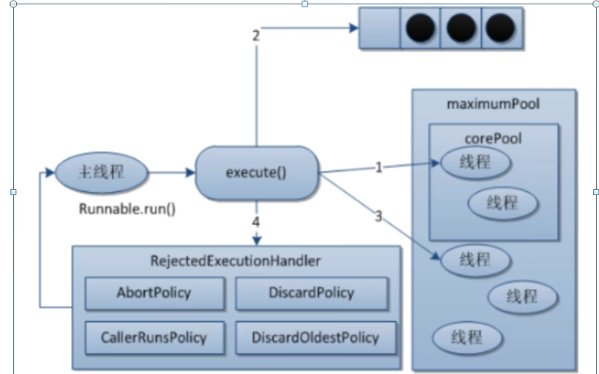
- 当执行execute()后,线程池才创建
- 当常驻线程数被占满,阻塞队列也被占满,此时再来一个新的任务,那么会优先去最大线程中执行
9.6拒绝策略
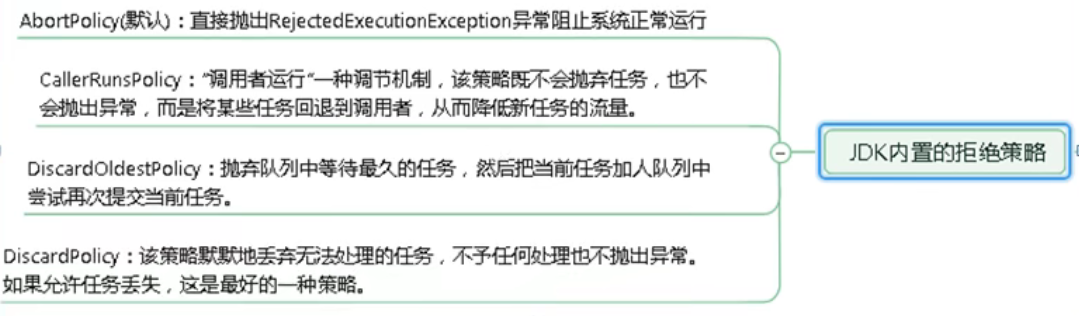
9.6.1JDK内置的拒绝策略
9.7自定义线程池(常用)
package com.xzhang.pool;

import java.util.concurrent.*;

/**
 * @author xzhang
 * @version 1.0
 * @date 2021/11/29 15:38
 */
public class ThreadPoolDemo2 {
    public static void main(String[] args) {
        ExecutorService threadPool = new ThreadPoolExecutor(
                2,
                5,
                2L,
                TimeUnit.SECONDS,
                new ArrayBlockingQueue<>(3),
                Executors.defaultThreadFactory(),
                new ThreadPoolExecutor.AbortPolicy()
        );


        try{
            for (int i = 1; i <=10 ; i++) {
                threadPool.execute(()->{
                    System.out.println(Thread.currentThread().getName()+"正在执行");
                });
            }
        }catch (Exception e){
            e.printStackTrace();
        }finally {
            threadPool.shutdown();
        }

    }
}